
Every few years, a new piece of detection technology arrives with confident claims: faster results, higher accuracy, less human involvement. And every few years, the organizations that rely on it discover the same limitation — technology performs well in controlled conditions, but workplaces are not controlled environments.
This isn’t an argument against technology. It’s an explanation of why detection dogs remain the most reliable option for workplace narcotic detection, and why that gap is wider than most people expect.
What Technology Can and Cannot Do
Trace detection devices, such as ion mobility spectrometers, work by identifying chemical signatures on surfaces or in the air. They’re effective in airports, where conditions are standardized, volumes are predictable, and maintenance schedules are rigorous.
In industrial workplaces, those conditions rarely exist. Temperature fluctuations, dust, chemical interference from cleaning products or industrial materials, and equipment that needs recalibration can all affect accuracy. False positives create disruption. False negatives create a false sense of security.
Urinalysis and saliva testing are widely used but detect past exposure, not current impairment. A worker who used cannabis two weeks ago may test positive. A worker who used methamphetamine the night before may still be impaired when they arrive on site.
What a Dog’s Nose Actually Does
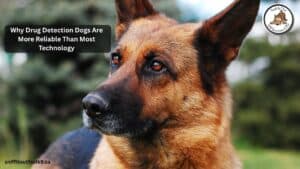
A trained detection dog doesn’t just smell more than a human — it processes odor in a fundamentally different way. The canine olfactory system contains roughly 300 million scent receptors, compared to around six million in a human nose. More importantly, a dog can isolate individual components within a complex scent environment.
In practical terms, this means a dog can detect the presence of a controlled substance even when it’s concealed inside a container with other strong-smelling items, stored in a vehicle that hasn’t been used in days, or present only in trace amounts from residual contamination.
Detection technology aims to replicate this capability but hasn’t matched it. The variability of real-world conditions — temperature, humidity, cross-contamination, packaging materials — continues to create accuracy gaps that dogs don’t share.
| In field conditions, trained detection dogs consistently demonstrate sensitivity to target substances at concentrations that current detection devices cannot reliably identify. This isn’t a marginal difference — it’s the reason law enforcement agencies worldwide have not replaced dogs with machines. |
Adaptability: The Factor Technology Can’t Engineer
Detection dogs adapt naturally to new environments. A dog that has worked in an Edmonton oilfield camp, a Vancouver warehouse, and a rural Manitoba school brings the same capability to each setting without reconfiguration.
Technology doesn’t transfer that way. Different environments often require different equipment, recalibration, or different operators. A device calibrated for one type of site may underperform in another.
Dogs also adapt to new substances more readily than devices. When fentanyl became a significant concern in workplace environments across Alberta and BC, trained dogs were already capable of detecting it. Updating a detection device often requires hardware changes, new detection cartridges, or manufacturer updates that take time to deploy.
The Deterrence Difference
This is a factor technology rarely provides: visible deterrence.
When employees know that a trained K9 team conducts regular inspections, the calculation around bringing substances onto a worksite changes. The presence of a working dog is a concrete, visible safety measure in a way that a scanner in a back office is not.
Organizations that have implemented regular K9 detection programs consistently report fewer substance-related incidents within the first year — not just because of what the dog finds, but because of what people choose not to bring.
When Technology and K9 Detection Work Together
The most effective workplace safety programs don’t choose one or the other. Urinalysis testing identifies individual impairment when triggered by post-incident protocols or reasonable cause. K9 detection handles proactive environmental sweeps. Policy and communication create the cultural framework.
Each layer catches what the others miss. A positive K9 indication might trigger targeted testing. A policy violation might prompt an unannounced sweep. Together, these measures create a deterrence environment that individual tools cannot achieve alone.
Frequently Asked Questions
How accurate are drug detection dogs compared to laboratory testing?
Trained detection dogs have demonstrated accuracy rates above 90% in controlled assessments, with some studies reporting higher. Laboratory urinalysis is highly accurate for individual testing but detects past use, not environmental presence. The two tools answer different questions and are most effective when used together.
Can detection technology replace drug detection dogs entirely?
Not currently, and likely not in the near future. Detection technology continues to improve, but the real-world adaptability, sensitivity range, and deterrence effect of a trained K9 team remains unmatched in variable workplace environments. Law enforcement agencies worldwide continue to use working dogs despite significant investment in detection technology.
What substances can dogs detect that technology often misses?
Dogs are particularly effective at detecting fentanyl and its analogues, novel psychoactive substances, and substances concealed within complex packaging or mixed with masking agents. These scenarios often produce false negatives in current detection devices but are well within the capability of a properly trained detection dog.
Is K9 detection more expensive than technology-based alternatives?
The cost comparison depends on the frequency of use and the size of the facility. Detection technology has upfront hardware costs plus ongoing maintenance and calibration. K9 detection is typically priced per inspection. For most organizations, a quarterly K9 program is cost-competitive with maintaining detection hardware and produces more reliable results.