
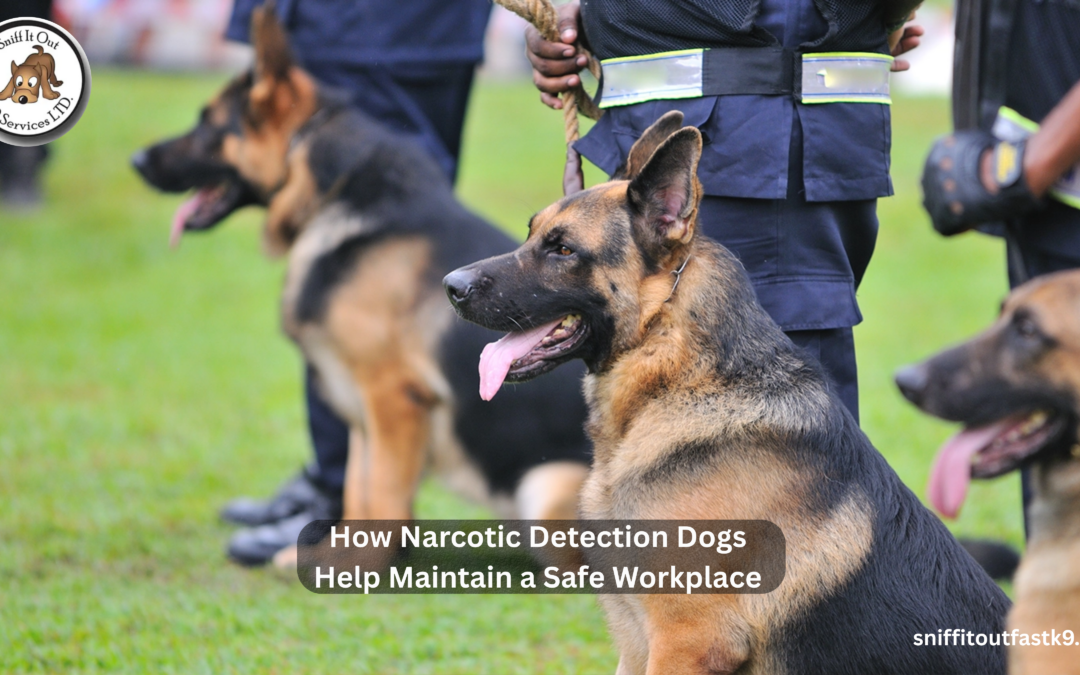
There’s a version of this that people imagine — uniformed officers, tense employees lined up in a hallway — and then there’s what actually happens. A professional K9 inspection is quiet, efficient, and in most cases, employees don’t notice it at all.
Understanding how workplace drug detection dogs operate helps employers make better decisions about their safety programs and helps employees understand that the process is built around protection, not punishment.
The Inspection Process, Step by Step
Before any search begins, our team works with the employer to understand the site layout, identify the areas to be inspected, and agree on a process that fits the company’s existing safety policies.
On the day of the inspection, the handler and dog move through approved areas. The dog works off-leash in most environments, following a systematic pattern through the space. If the dog detects a target scent, it gives a trained passive alert — typically sitting near the source rather than barking or scratching. The handler marks the location, documents the finding, and the employer’s HR or safety team determines next steps.
The dog does not interact with employees and does not search individuals. Searches are limited to the physical spaces and items the employer has designated.
Why the Non-Invasive Approach Matters
One of the most common concerns employers raise is employee relations. Will staff feel surveilled? Will morale suffer?
In our experience, the opposite tends to happen. Employees who understand the purpose of a detection program — keeping the workplace safe for everyone — generally support it. The key is transparent communication before the first inspection.
When a company rolls out a K9 detection program as part of a broader safety initiative and communicates clearly about what it does and doesn’t involve, acceptance is high. Employees appreciate that someone is taking workplace safety seriously.
| K9 detection dogs alert to the presence of substances in a space — they do not identify or accuse individuals. The process is built to be fair, consistent, and legally defensible. |
What Happens After a Positive Indication
A trained alert from a detection dog is not a disciplinary action — it is information. What the employer does with that information is determined by their drug and alcohol policy and legal obligations.
Our team provides documentation of the indication and the location. From there, the employer’s HR and safety teams follow their established procedures. We are available to provide written reports and, in some cases, testimony or documentation for legal proceedings.
Our handlers have backgrounds in law enforcement, which means we understand how to document findings in a way that holds up to scrutiny.
Industries That Use K9 Inspection Services in Canada
Workplace drug detection dogs are used across a wide range of sectors:
- Oil and gas: Camp inspections, vehicle checks, and shift-change sweeps at remote sites
- Construction: Pre-shift sweeps on large project sites and equipment yards
- Transportation and logistics: Fleet inspections and warehouse checks
- Manufacturing: Facility sweeps during scheduled maintenance windows
- Corporate offices: Discrete inspections conducted after hours
- Schools and institutions: Controlled environments requiring regular monitoring
Each environment requires a slightly different approach, and our team adapts the inspection protocol to fit the site.
Frequently Asked Questions
How much notice do employees receive before a K9 inspection?
This depends on the employer’s policy. Some organizations conduct announced sweeps as a deterrence measure. Others prefer unannounced inspections for compliance purposes. We advise on what works best for each environment and help employers communicate their approach clearly in advance.
Can a K9 inspection result be used in a legal proceeding?
Yes. Our handlers are trained in proper documentation procedures. Because of our team’s law enforcement background, our reports are structured to be legally defensible. We have provided documentation and testimony in proceedings in Alberta and British Columbia.
How often should a workplace conduct K9 inspections?
Most organizations benefit from quarterly inspections as a baseline deterrence measure, combined with post-incident searches when triggered by a specific concern. High-risk environments such as remote camps may require monthly sweeps. We work with each client to determine the right frequency for their situation.