
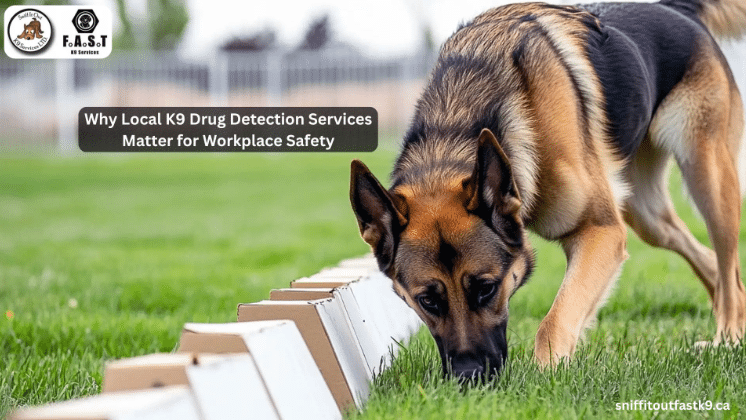
Workplace drug detection is most effective when it is treated as part of a broader safety strategy, not as a one-time reaction to an incident. Local K9 detection teams can help businesses search designated workplace areas efficiently, reinforce clear safety expectations, and respond quickly when a company needs an inspection.
For employers, the value goes beyond finding a prohibited substance. It is about knowing that reasonable steps are being taken to protect the people who walk through the workplace every day.
Why Does Local K9 Support Matter?
A safety issue rarely waits for a convenient time.
A site manager might receive a concern late on a Thursday afternoon. A supervisor might notice something unusual during a night shift. A company could also be preparing for a major project where hundreds of workers, contractors, vehicles, and equipment will be moving through the same location.
When the need for an inspection arises, having a provider nearby can make the process much easier.
A local team may be able to coordinate scheduling, understand the site’s layout, and accommodate the practical realities of the business without the added complications of arranging long-distance travel.
That matters particularly in industries where operations can’t simply stop for half a day while a service provider travels to the site.
Local Knowledge Can Make Inspections More Practical
Every workplace has its own rhythm.
A manufacturing plant may have restricted production areas, employee lockers, maintenance rooms, and multiple shifts. A construction project might have trailers, equipment cabs, temporary storage, worker vehicles, and changing site boundaries.
A warehouse can be even more complicated, with loading docks, employee parking, inventory areas, break rooms, and constant movement between shifts.
A provider that regularly works with these environments understands that an inspection needs to fit into the operation rather than disrupt it unnecessarily.
This is one reason businesses looking for Drug dog searching Alberta services may prefer working with a team that understands local industrial and commercial environments.
Faster Response When Circumstances Change
Timing can make a significant difference.
Imagine a construction manager receives a workplace concern on Monday morning. The company doesn’t necessarily want to wait several days for an inspection simply because the provider is based hundreds of kilometres away.
A local provider may have greater flexibility to arrange a visit based on the site’s circumstances.
That doesn’t mean every concern requires an immediate K9 search. It means businesses have another practical option when they need professional support without dealing with unnecessary travel arrangements.
For large organizations with multiple facilities, this can become especially useful. A regional provider may be able to support several locations while maintaining a more consistent approach across the company’s safety program.
How K9 Detection Supports Workplace Safety
Professional detection dogs are trained to identify specific target odours. During an inspection, the handler directs the dog through agreed search areas while observing its behaviour and indications.
The process is focused on the physical environment.
That can include designated areas such as vehicles, lockers, storage spaces, equipment, trailers, or other locations identified in the inspection plan.
This makes K9 detection different from employee testing. A workplace search is intended to identify whether target substances may be present in the environment, while testing an individual involves separate procedures and legal considerations.
Neither approach automatically replaces the other.
A well-designed workplace safety program considers what type of risk it is trying to address and chooses appropriate measures accordingly.
Building Deterrence Without Creating a Hostile Workplace
This is where communication matters more than many employers realize.
The moment employees hear the words “drug search,” some may immediately assume management is looking for someone to blame. If the program is introduced poorly, that perception can create unnecessary anxiety and resentment.
The message should be different.
A company can explain that K9 inspections are one part of its overall commitment to a safe workplace and that the same safety expectations apply across the organization.
That approach feels much more reasonable to employees.
People generally understand why a company checks fire equipment, inspects forklifts, monitors emergency exits, and audits safety procedures. Environmental drug detection can be presented through the same prevention mindset.
The goal isn’t to make employees feel watched every minute of the day. It’s to make the workplace standard clear.
Local Providers Can Build Familiarity Over Time
There is a human side to safety that isn’t captured in a spreadsheet.
When the same professional team works with a company repeatedly, employees become familiar with the handlers and the process. The inspection becomes less mysterious.
That familiarity can help remove some of the tension that often surrounds workplace searches.
A professional handler knows how to work around employees, communicate with site management, and keep the inspection controlled. The dog is there to perform a specific detection task, not to create a spectacle.
Over several inspections, that consistency can make the process feel more like another routine safety activity.
Local Expertise vs. Distant Service Providers
| Factor | Local K9 Provider | Distant Provider |
| Travel requirements | Usually simpler | May require significant travel |
| Scheduling flexibility | Often easier to coordinate | May depend on travel availability |
| Regional familiarity | Stronger understanding of local conditions | May require additional site orientation |
| Repeat inspections | Easier to maintain continuity | Can involve changing personnel |
| Emergency or short-notice requests | Potentially more practical | May be more difficult to arrange |
| Long-term relationship | Easier to develop locally | May be more transactional |
The right provider still depends on qualifications, training, procedures, experience, and the employer’s specific requirements. Location alone shouldn’t determine the decision.
Why Consistency Matters More Than a One-Time Search
One inspection can provide useful information, but workplace safety isn’t a one-day exercise.
Think about how other safety programs work.
Companies don’t inspect a forklift once and then assume it will remain safe forever. They don’t conduct one fire drill and consider emergency preparedness finished.
The same thinking applies to environmental detection.
Businesses may choose periodic inspections based on their risk profile, internal policies, operational environment, and applicable requirements. Some may use scheduled visits, while others may incorporate unannounced inspections where appropriate.
The objective is to create a system that employees understand and management can maintain.
The Human Reason Behind Workplace Safety
There’s an uncomfortable reality behind every workplace safety policy.
Most managers don’t worry about safety because they enjoy paperwork. They worry because they know the people on their site.
They know the employee who has been with the company for ten years. They know the supervisor who has two young children at home. They know the contractor who drives an hour every morning just to reach the site.
When something goes wrong, those aren’t numbers on an incident report. They’re people.
That is why prevention carries so much emotional weight.
A close call can stay in a manager’s head for days. You replay what happened. You think about how easily the outcome could have been different. You wonder whether another safeguard could have prevented it.
A professional detection program can’t eliminate every workplace hazard, but it can form one part of a broader effort to reduce avoidable risks.
Choosing a K9 Provider in Alberta or BC
Businesses considering Narcotic detection canine Alberta services should look beyond the dog’s ability to detect target odours.
Ask about the team’s training, handler experience, inspection procedures, reporting practices, insurance, and how they handle workplace interactions.
The same applies to businesses searching for Narcotic dog searching Alberta or Narcotic dog searching BC services.
A professional provider should be able to explain the process clearly before arriving at the site. You should understand what areas will be searched, how the inspection will be conducted, what happens if the dog gives an indication, and how information will be communicated afterward.
If your company operates in British Columbia, Drug dog searching BC providers may also offer regional experience that can make recurring inspections easier to coordinate.
Most importantly, don’t choose a provider simply because the service sounds impressive. Ask practical questions.
How experienced are the handlers?
What environments have they worked in?
How are searches documented?
How do they minimize disruption?
What support do they provide after an indication?
Those answers tell you far more than marketing language.
FAQ
Are local K9 inspections only useful for large industrial companies?
No. Smaller warehouses, construction companies, transportation businesses, commercial facilities, and other workplaces may also use professional detection services where appropriate.
How often should a company schedule a K9 inspection?
There isn’t one universal schedule. Frequency should reflect the workplace’s risk profile, operational environment, policies, and applicable legal requirements. Some businesses use periodic inspections, while others combine scheduled and unannounced visits.
Do K9 searches involve testing employees?
Not necessarily. A K9 inspection generally focuses on designated physical areas. Individual testing is a separate process with its own considerations.
Can K9 teams search company vehicles?
Depending on the agreed scope and workplace policies, vehicles can be included in an inspection. Employers should establish the search areas and procedures with the provider beforehand.
What should businesses look for in a K9 detection provider?
Look for experienced handlers, properly trained detection dogs, clear procedures, professional reporting, appropriate insurance, and experience working in environments similar to yours.
Conclusion
Local K9 drug detection services aren’t a replacement for a complete workplace safety program. They are another tool that can help employers identify potential environmental risks and reinforce the standards they’ve already established.
The biggest advantage of working with a local provider is often practical. Better availability, regional familiarity, easier communication, and the ability to build a long-term working relationship can make regular inspections much easier to manage.
More importantly, a professional approach keeps the focus where it belongs: workplace safety.
If you’re concerned about prohibited substances entering your facility, don’t wait until a close call forces the conversation. Speak with a professional K9 detection team about your workplace, the areas you need covered, and the inspection approach that makes sense for your operation.
Contact our team today to arrange a confidential consultation and create a practical K9 inspection plan designed around your workplace.